As institutions move from crypto exposure to onchain execution, they face a challenge of operating safely in a market defined by instant settlement, irreversible transactions, and 24/7 risk.

The institutional debate about crypto is over.
In the past two months alone: Fidelity launched a dollar-denominated stablecoin on Ethereum. Deutsche Bank integrated Ripple infrastructure for payments. Morgan Stanley filed for Solana ETFs. These are not exploratory pilots or press release moves. They are production commitments from institutions that manage trillions in assets.
The question is no longer whether to go onchain. It's how to operate there safely, at scale, without importing the assumptions that made traditional finance feel safe.
Wall Street has been through this before. In the late 1960s, the NYSE was forced to close every Wednesday because the back office was choking on paper. Trading volumes had surged, but the market still depended on clerks, messengers, and physical stock certificates to settle trades. The problem was an operating model built for a slower era.
When trading went electronic over the following decade, Wall Street did not just gain speed. It inherited new failure modes. Fat finger errors became eight-figure losses before anyone could pick up a phone. Knight Capital's algorithm burned $440 million in 45 minutes because a software error could now execute four million trades before a human noticed. The 2010 Flash Crash erased nearly a trillion dollars in market cap (then partially recovered), all before most risk managers had processed what was happening.
In the floor-trading era, human friction often absorbed small mistakes before they became major incidents. In electronic markets, that friction disappeared, and institutions had to build a new control layer to survive the consequences. The same reckoning is coming for institutions going onchain.

Electronic markets changed how fast things moved. Onchain changes what moving means.
In traditional finance, systems are designed around fallibility. Trades fail and settle tomorrow. Transactions reverse. Humans review exceptions. Compliance happens after the fact. That architecture works because time is a resource: you can use it to catch mistakes before they become permanent.
Onchain, time collapses. Execution, settlement, and compliance often happen in a single atomic moment. A transaction either succeeds or it doesn't. There is no T+1. There is no call to your prime broker. There is no chargeback.
That's not a bug. It's the design. And it's exactly what makes blockchains valuable for institutional use: efficiency, transparency, programmability. But it also means the entire risk model has to move upstream.
Prevention replaces recovery. You must understand what a transaction will do before it executes, not after funds move.
Read more: Solving the Institutional Web3 Trilemma with Hypernative Guardian
Most institutions building their onchain risk frameworks focus on the obvious vectors: custody, key management, smart contract audits. Those matter. But they miss the operational layer, the category of incidents that aren't hacks, but shouldn't have happened.
None of these are "hacks" in the traditional sense. They're operational incidents. And in a 24/7, multi-chain environment, they propagate in seconds across chains, across protocols, across counterparties.
The firms that experience them often had the right policies. What they lacked was the infrastructure to enforce those policies at the speed the environment demands.
Read more: Operational Security Against State-Level Threats
The institutions operating well onchain have shifted their risk posture from reactive to preventive. They're not just monitoring for hacks, they're enforcing policies before transactions execute.
That means simulating transaction intent, not just reading destination addresses. It means knowing the real-time state of every protocol a position touches. It means having automated responses that can pause, block, or escalate before a window closes. And it means doing all of this across every chain, wallet, and vault, continuously, not on a review cadence.
The firms that have built this infrastructure (hedge funds, asset managers, payment providers, stablecoin issuers) describe the same outcome: their security teams stopped being blockers and started being enablers. Risk became something they could operationalize, not just worry about.
That's the shift institutional DeFi needs to make at scale. The infrastructure exists. The question is how quickly the operational standard catches up to the capital being deployed.
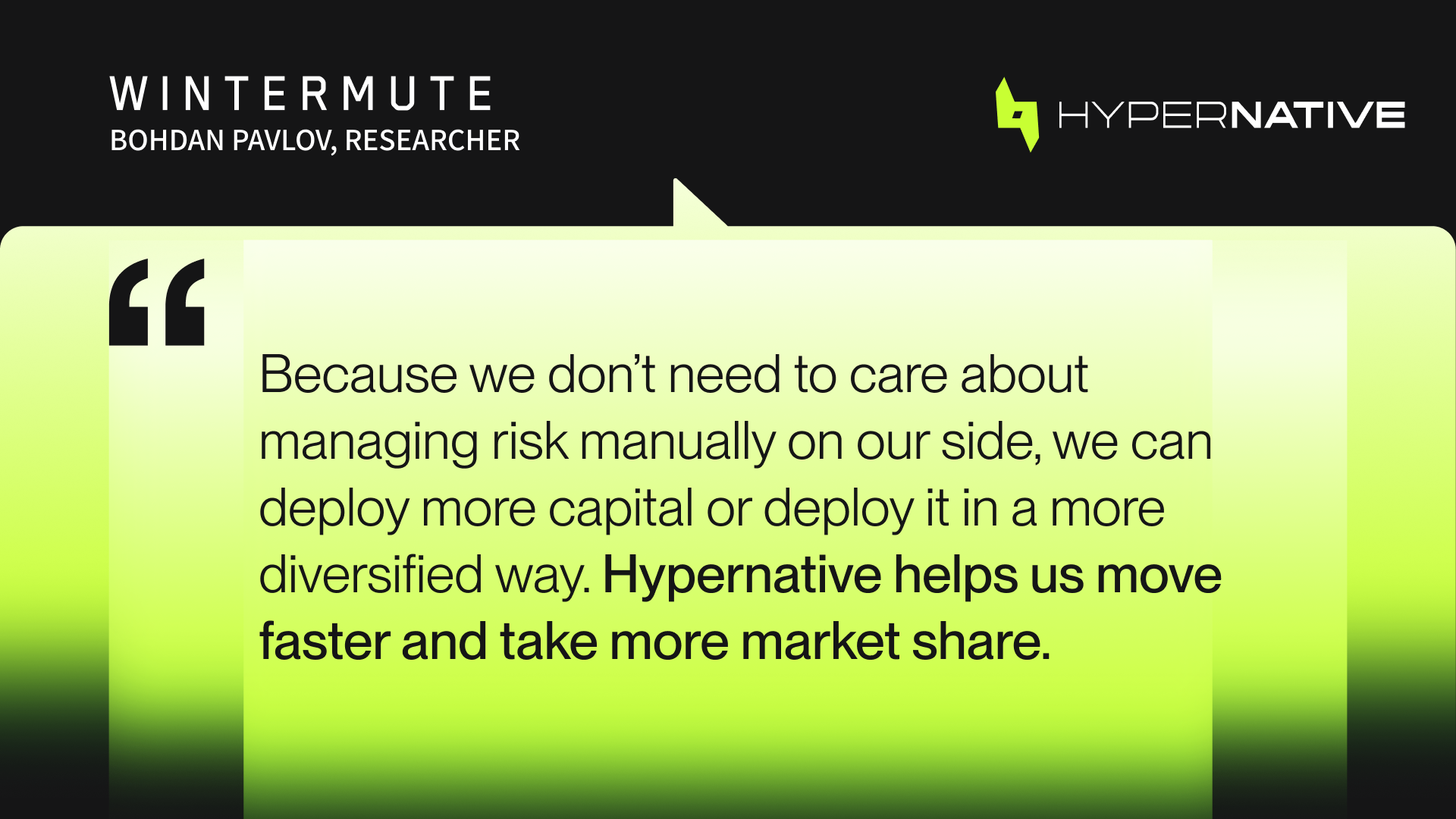
Read more: How Wintermute Scaled Their DeFi Farming Operations with Real-Time Risk Monitoring
Hypernative Platform uses battle-tested, sophisticated machine learning models, heuristics, simulations, and graph-based detections to identify threats with high accuracy and give customers precious minutes to respond before exploits can do damage. The system monitors security, technical, financial, governance and other risks. Hypernative Platform detected 99.5% of hacks last year with less than 0.001% false positive rate and saved $3B of funds to date.
Over 300 Web3 projects already rely on Hypernative’s real-time enterprise-grade platform that monitors over $100B worth of digital assets across more than 70 chains. The list includes Circle, Chainlink, Ethena, Galaxy, and Morpho.
Reach out for a demo of Hypernative’s solutions, tune into Hypernative’s blog and our social channels to keep up with the latest on cybersecurity in Web3.
Secure everything you build, run and own in Web3 with Hypernative.
Website | X (Twitter) | LinkedIn