In a top-5 crypto exchange benchmark test, Hypernative detected 96% of scam addresses and flagged $1.8M in real time. Two other competitors weren't even close.

When it comes to onchain fraud prevention, not all tools are solving the same problem. Legacy blockchain analytics platforms were built for compliance and post-transaction investigation, tracing funds after they've moved and generating reports for regulators. A benchmark study conducted at a top-five global cryptocurrency exchange in August 2025 put a number on what that difference costs.
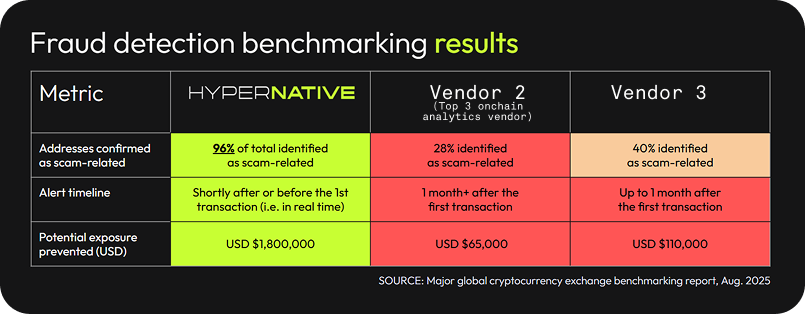
Across three vendors evaluated on the same dataset, Hypernative identified 96% of tested addresses as confirmed scam-related. The two competing vendors identified 28% and 40%, respectively.
On potential exposure prevented, Hypernative flagged $1.8 million in at-risk funds. The other two vendors reached $65,000 and $110,000.
On alert timing, Hypernative generated signals in real time, at or before the first fraudulent transaction. The competing vendors issued alerts one month or more after the fact.
The benchmarking results point to two questions any fraud or risk team should be asking when evaluating a solution.
For exchanges and institutions evaluating their current fraud stack, the benchmark offers a concrete reference point. The gap between vendors on the core metrics, accuracy, speed, and exposure prevented, is not marginal. It is the difference between a tool that stops fraud and one that records it.
We are hosting a session for fraud, risk, and compliance teams at exchanges, payment providers, and financial institutions who are thinking seriously about what prevention-first actually looks like in practice.
The Onchain Fraud Prevention Blueprint: Why Investigation-First Is Failing Digital Asset Organizations
🗓️April 9, 1 PM UTC / 9 AM EST
Register here: https://luma.com/k2sddnh6
Reach out for a demo of Hypernative’s solutions, tune into Hypernative’s blog and our social channels to keep up with the latest on cybersecurity in Web3.
Secure everything you build, run and own in Web3 with Hypernative.
Website | X (Twitter) | LinkedIn