



Recent events across the crypto ecosystem have made one thing clear: for mission-critical operations like compliance, relying on a single vendor is a serious risk. When that vendor goes down, screening stops, alerts go dark, and the business is left exposed, sometimes for hours, sometimes longer. That is why redundancy has become the responsible approach, not a nice-to-have.
But it raises a practical question we hear from customers again and again: how do you choose the backup vendor? The baseline requirement is obvious. Your second vendor must be able to fully take over compliance operations until your primary provider recovers. In this article, we look beyond that baseline and map the additional criteria that should guide your choice.
A maturing industry plays by the rules
Crypto compliance has grown up. Banks, asset managers, payment companies and the largest protocols now run screening programs that regulators expect to work every hour of every day. That is a sign of a maturing industry, and it raises the bar for the tools behind those programs.
Most compliance vendors were built for an earlier market: one where funds moved slowly, attacks were rare, and a daily or even hourly list update was good enough. The market has changed faster than their coverage. This article walks through the four gaps we see most often among our financial institution customers, and what closing them looks like.
Higher stakes, higher risks: the Binance hack
Before we get to the gaps, it's worth looking at how much the onchain economy has changed in recent years. As more money flows into crypto, the prize for attackers grows with it. On October 29, 2026, attackers drained more than $6 billion from Binance's hot wallets, most of it within about an hour. That is roughly four times the approximately $1.5 billion Bybit theft in February 2025, and the largest crypto theft on record.
On October 31, the FBI attributed the theft to North Korean state-sponsored hackers and urged firms to block transactions with or derived from the addresses being used to launder the funds. Stablecoin issuers froze part of the haul, approximately $3 billion by Binance's count. The rest entered the laundering pipeline: fresh wallets, bridges, DEXs and DeFi protocols, across multiple chains.
That is the compliance problem. Every hop creates a new address with no history and no label. Any of them can reach your pools, your deposit addresses or your counterparties' wallets, and a screening tool that doesn't pick up the hack as it unfolds will clear them.
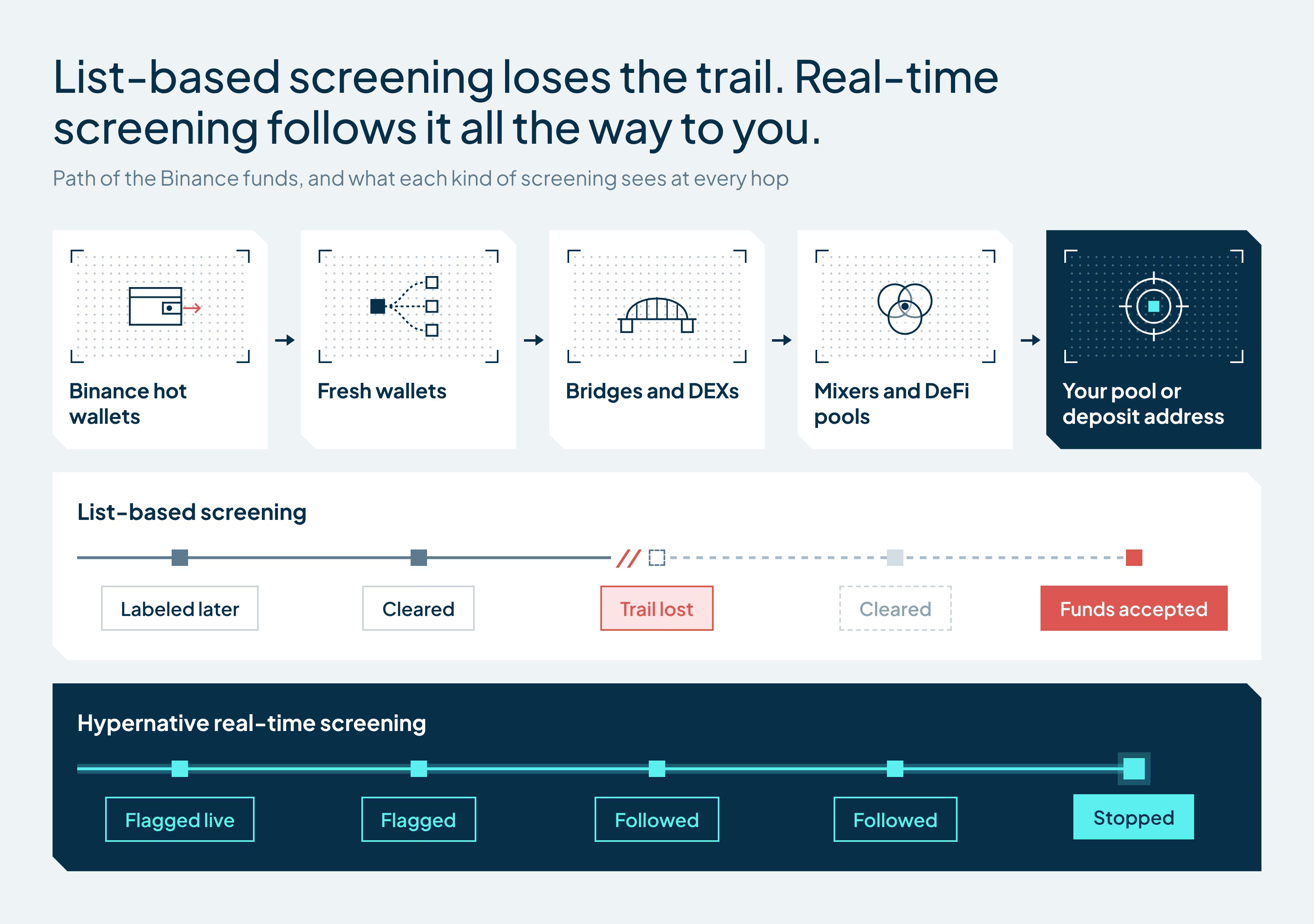
Sources: Hypernative case study · Kuwait Times · Tech Insider
The compliance landscape today
Crypto now has a rulebook in its biggest markets, and it looks a lot like the one banks already follow in traditional finance. The details differ by jurisdiction, but the expectations are converging:
- United States: The GENIUS Act establishes a dedicated framework for payment stablecoin issuers. Federal BSA/AML and OFAC obligations address money laundering, other illicit activity and sanctions compliance. These sit alongside state requirements, including money-transmitter licenses. New York’s BitLicense rules also require annually tested recovery plans and seven-year retention of transaction and compliance records.
- European Union: MiCA licenses crypto-asset service providers, and the Transfer of Funds Regulation applies the Travel Rule to every crypto transfer. DORA makes firms manage the risk of their critical tech vendors.
- Everywhere else: FATF's Travel Rule is being adopted market by market, and licensing regimes in Dubai (VARA), Singapore (MAS) and Hong Kong follow the same pattern.
In practice, regulated firms are expected to screen the wallets they deal with, monitor transactions for exposure to sanctioned or illicit funds, and keep an audit trail that proves both. As the risks grow larger and more complex, compliance tooling needs an upgrade too.
Where compliance is headed
The direction is clear: from periodic checks to continuous proof. Three shifts are driving it.
- Real time, not after the fact. Regulators and partner banks increasingly expect risky funds to be stopped before they settle, not flagged in a batch review days later.
- Security and compliance are complementary parts of the full picture. Security and compliance complete each other. Compliance checks who you’re dealing with, and security catches the attacks behind the funds. The FBI’s Binance notice asked firms to block funds derived from a hack, a reminder that you need both to see the full picture.
- Resilience is part of compliance. Rules like DORA treat a critical vendor going down as your risk to manage. "Our provider was offline" won't satisfy a regulator.
Most screening tools were built for the old model: labeled address lists, updated on a schedule, checked one address at a time. That is where the blind spots come from.
4 blind spots your current compliance vendor doesn't cover
1. No live, real-time updates
When a hack happens, the clock starts immediately. In the Binance theft, most of the funds left within an hour and were moving through fresh wallets soon after. A vendor that labels addresses on a schedule will keep clearing those wallets until its next update, and by then the funds may already sit in your pools or customer accounts.
Hypernative’s screening draws on risks our monitoring detects live onchain. On supported chains, that means an address tied to an active attack can be flagged while the attack is still unfolding, instead of waiting for the next list update.
2. Blindness to hacks and exploits
Attacks grow with the money in the industry. Traditional compliance vendors focus on sanctions lists and known illicit categories; hacks and exploits are someone else's problem until the stolen funds get a label.
Detecting hacks and exploits is Hypernative's core business. We see attacks from the setup stage, understand how they are engineered, and follow the proceeds through laundering steps and mixers. That means better protection from interacting with the actors behind them, often before any list has caught up. Every detection can trigger an immediate, automated response, with a false positive rate below 0.001%. That is why so many financial institutions trust us with real-time, mission-critical operations.
3. Single-vendor dependency
In mission critical operations such as compliance, single vendor dependency can pose a dual risk. The first risk is visibility as no single provider sees everything. Each has its own data sources and its own blind spots, so a program built on one vendor inherits whatever that vendor misses. A second provider widens what you can detect and surfaces exposure the first one never flags.
The second risk is uptime and reliability. Any provider can go offline after a security incident or an infrastructure failure, and customers can access to monitoring for a day or more while their regulatory obligations keep running. A tested secondary provider that is already integrated and running turns an outage into a non-event. And when that second provider also covers what your primary can't, the decision is easy.
4. Compliance in a silo
Screening addresses and transactions on its own gives a partial picture. It tells you who a counterparty is, not whether the position you hold is about to be exploited, or whether the transaction you're about to sign does what it's supposed to do.
Compliance works best inside a single platform that also monitors your positions and addresses onchain and validates transactions before they're signed, backed by professional services, 24/7 support and enterprise features like SOC 2, SSO and audit logs. That is the only way to give your teams full holistic visibility into their onchain activity and every risk it creates, and the ability to respond to all of it immediately, with a setup that is simple and clear.
One platform, full coverage
The four gaps have the same root: compliance tools built for a slower, simpler market. Closing them takes screening that updates in real time, understands hacks and DeFi, runs as a reliable second line, and works alongside monitoring and pre-transaction security.
That is what Hypernative brings together: compliance screening, onchain monitoring and automated response, and Transaction Guard, on one platform covering 75+ chains, with more than $3B in losses prevented to date. Our false positive rate, below 0.001%, is a big reason some of the largest financial institutions trust us to respond automatically on their behalf when an incident hits.
See where your coverage stands. Book a free coverage assessment and we'll map your current screening setup against these four gaps. [CTA: Request a coverage assessment]